

Showing posts with label news literacy. Show all posts
Showing posts with label news literacy. Show all posts
Wednesday, August 1, 2012
GlobalGirl Media in Chicago
Wednesday, August 01, 2012
Chicago’s GlobalGirl Media (GGM) class begins with yoga and ends with hands-on youth journalism. The course teaches girls how to stretch their comfort zones, ask questions, find stories and share what they’ve learned with broader audiences, among others. According to Elizabeth Czekner, GGM program director, the girls have been arriving to the 4-week workshop around a half hour before class even starts—eager to get started each morning.
The McCormick Foundation-funded organization is dedicated to empowering girls from underserved communities around the world through media, leadership and journalistic training to have a voice in global issues. Chicago’s program, in partnership with Free Spirit Media (FSM) and Chicago Public Schools, launched July 9 and will consist of a four-week summer training academy designed to inspire community activism and social change through youth journalism.
Students who’ve expressed an interest in journalism and/or writing were chosen from schools around the city and range in age, from high school sophomores to seniors. By the end of the school year, the 15 students will complete a package of stories that will be featured on GGM’s website, including investigations into teen pregnancy, gun violence, health issues and the prison system.
“At this point, each of them has been in front of and behind the camera at least once,” Czekner said. “They’re in essence a news bureau.”
Along with GGM groups in Los Angeles, South Africa and Morocco, Chicago’s team has been having conversations about media and news literacy.
“The goal is that [the groups] start to collaborate as well as report on stories in their own neighborhoods,” Czekner said.
To do that, the girls in all three groups are trained in a wide variety of mediums, including print, broadcast, photography and online news. Each student maintains an ongoing blog where she records her experiences over the course of the school year.
“My teaching philosophy is theory and practice,” said GGM/FSM program coordinator Ovetta Sampson, an experienced journalist whose work has appeared in the Washington Post, The Boston Globe and The San Jose Mercury News, among others.
“I’m so proud of them because they’re doing it all.”
At the end of the day, the girls show how media-savvy and literate youth already are. As part of GGM, they’ll learn to focus that innate knowledge on their future pursuits.
According to 15-year-old J’doria Taylor, her particular goal for the school year is “to inform other people and let other teens know that they can do the same.”
Check out the following pictures from out trip to GGM's week two workday at George Westinghouse College Prep High School. For more info, videos, pictures and stories from GGM please visit their website and/or blog.


Wednesday, May 30, 2012
MF Youth Impact Study 2010
Wednesday, May 30, 2012
The McCormick Journalism Program conducted a survey of its 2010 news literacy and youth journalism grantees to determine the impact of programs in Chicago.
MF staff created a 12-question Survey Monkey questionnaire that asked about partnerships with high schools, youth reached, teachers trained and neighborhoods where programs take place. Data was collected from the CPS Office of Performance, and was later used by the Urban Data Visualization Lab at the University of Illinois at Chicago to produce maps using ArcGIS.
Findings:


MF staff created a 12-question Survey Monkey questionnaire that asked about partnerships with high schools, youth reached, teachers trained and neighborhoods where programs take place. Data was collected from the CPS Office of Performance, and was later used by the Urban Data Visualization Lab at the University of Illinois at Chicago to produce maps using ArcGIS.
Findings:
- Some 23 MF-funded youth journalism and news literacy organizations served 6,874 young people in the Chicago area.
- These students live in 43 of the city’s 77 neighborhoods, with the most activity in Roseland, Englewood, Grand Boulevard, Humboldt Park and North Lawndale.
- Grantees reached students in 87 Chicago schools and 23 other schools in the suburbs.
- Grantees trained 153 teachers.
- 2,484 students in 32 Chicago Public Schools were directly reached by news literacy programs.
- 53 teachers received news literacy training.
- 4,390 students in 78 Chicago Public Schools were directly reached by MF youth journalism grantees.
- About 100 teachers received youth journalism training.


Monday, April 2, 2012
Why News Matters: Sailing
Monday, April 02, 2012
Ever since we started to move our attention toward the audience and issues of information credibility, we’ve been astounded at how momentum is growing for what we and others are calling News Literacy.
Examples of news literacy ‘teaching moments’ seem to be coming at us in a flurry. From the Kony 2012 video to the Mike Daisey “This American Life” piece and retraction, as well as the purportedly leaked documents from the Heartland Institute, compelling examples abound. Each new instance raises – in very different ways – issues of credibility, bias, the difference between spin and high-quality reporting – and how to distinguish between the two.
But there’s more: We’re seeing and hearing testimony from a lot of people that they are as concerned as we are, and want to play a role in moving things in the right direction. At this point, in this nascent field, we’ve got more questions than answers: What are the most compelling ways for credible news and information to come alive for young people? Can the isolation of growing old in a big city be mitigated through the potential of digital information literacy to connect people? Can the young produce reporting that speaks beyond their peers and has meaning for all of us? How can news organizations use their platform to engage readers in dialogue and educate them about the mysteries of reporting? And as Richard Rodriguez explored in his Harper’s magazine essay two years ago: Who plays the role of helping to shape the identity of today’s cities? And is there a role for those engaged in workforce development, adult literacy, technology, the arts and other areas?
Here are just a few examples of ways that we see news literacy as being tremendously relevant:
Examples of news literacy ‘teaching moments’ seem to be coming at us in a flurry. From the Kony 2012 video to the Mike Daisey “This American Life” piece and retraction, as well as the purportedly leaked documents from the Heartland Institute, compelling examples abound. Each new instance raises – in very different ways – issues of credibility, bias, the difference between spin and high-quality reporting – and how to distinguish between the two.
But there’s more: We’re seeing and hearing testimony from a lot of people that they are as concerned as we are, and want to play a role in moving things in the right direction. At this point, in this nascent field, we’ve got more questions than answers: What are the most compelling ways for credible news and information to come alive for young people? Can the isolation of growing old in a big city be mitigated through the potential of digital information literacy to connect people? Can the young produce reporting that speaks beyond their peers and has meaning for all of us? How can news organizations use their platform to engage readers in dialogue and educate them about the mysteries of reporting? And as Richard Rodriguez explored in his Harper’s magazine essay two years ago: Who plays the role of helping to shape the identity of today’s cities? And is there a role for those engaged in workforce development, adult literacy, technology, the arts and other areas?
Here are just a few examples of ways that we see news literacy as being tremendously relevant:
· Knowledge is Power: The website from ClearHealthCosts includes
an interactive map based on Medicare data for actual pay for hospital stays.
Helps people see the different costs of the same procedure in the same city.
Simple and revolutionary.
· Open-Door Policy: University publications like Madison Commons in Wisconsin are doing a compelling
job of explaining their role and inviting readers to become engaged. The header
on their homepage says it all: Who we are, What we do, What you can do, Talk,
Tag cloud and Multimedia. Applause.
· YLCM: In a conversation with
New America Media’s Jacob Simas and Raj Jayadev, we noticed they’ve dropped the
term youth media and now talk about ‘youth-led community media.’ Young people
aged 14 and into their twenties are playing a role in reporting on community
issues. We see this same commitment to quality in other places: Witness Free
Spirit Media’s 10-minute documentary on food deserts in North Lawndale.
· The Event: When young people
learn to report, their journalism becomes a springboard for deeper civic
engagement. A great example is the “What’s hitting teens harder than adults?”
townhall organized by Columbia LINKS, where high school reporters launched a
special edition R-Wurd magazine at an event featuring experts and elected
officials. See the issue here.
It includes a cover story “Not Hiring: The plight of jobless teens,” as well as
a piece on hoodies as fashion. How timely.
· Creative Story Telling: Young journalists in particular are experimenting with
creative ways to connect with audiences. An example is the DC-based Pulitzer
Center, which sent a photojournalist and a poet to cover Haiti post-earthquake. Erin Polgreen
sent us this link to coverage of refugees in Damascus, in cartoon
format.
· An Editor’s Tough Love: Julia Lieblich, author of “Wounded I Am More Awake,” which
tells the story of a doctor who survived six Bosnian concentration camps, just
penned an op-ed for the Los Angeles Times. In it she lays out how after three
years of interviews for her book, her editor told her to go and confirm the
facts. So she went, as she says, to ‘fact-check horror.’ She lays out how this
ultimately led to richer
work.
· The Impact of Games: And back to kids. Students at the Reavis School on
Chicago’s South Side – in a News Literacy Project program – produced an audio
report on the impact of video games on their lives. It’s simply great work. The
story is here.
So many challenges and so many questions. But at least it seems there’s momentum on our side. Nice to have a little wind in your sails.
--Mark Hallett, senior program officer
Wednesday, March 28, 2012
Register Now: Webinar on Youth and Information Quality
Wednesday, March 28, 2012

The Berkman Center for Internet & Society and McCormick Foundation Present A Webinar on Youth and Information Quality.
A McCormick Media Matters Webinar
Date: April 20, 2012
Time: 2 pm CT/ 3 pm ET
FREE
Time: 2 pm CT/ 3 pm ET
FREE
Learn from experts at the Berkman Center about how young people interact with digital media. If you want to learn more about news literacy and get ideas for various news literacy applications for youth, you won't want to miss this free webinar!
Program Description
The Youth and Media Team at the Berkman Center for Internet & Society will introduce the concept of "information quality" and discuss where it comes from and why it's useful for looking at how young people interact with the Internet and digital media. Youth practices of searching for, evaluating, creating, and sharing online information will be at the center of this conversation. In many respects, such practices - and the underlying skills - form the core of “digital citizenship”. The Internet affords young people myriad opportunities to consume and create news information and to participate in online networks, which require various types of interactions with online information.
The webinar will start with a discussion of key insights from the Berkman report, “Youth and Digital Media: From Credibility to Information Quality.” The report describes the process by which youth engage with online information, including the connected phases of information seeking, evaluating, creating, and sharing. The report also considers how youths' dynamic process of information use can differ at home, among friends, or at school. After introducing these ideas, the webinar will discuss how the online news ecosystem is a rich setting for testing the potential of youth content creation. When youth create media, they often enhance their searching and evaluating skills in the process. By consuming and contributing news in new ways, youth are changing what it means to be a citizen and participant in online communities.
Register now
Register now
Wednesday, March 14, 2012
WBEZ's Eight Forty-Eight Features News Literacy
Wednesday, March 14, 2012
Our theory of change is that if we invest in news literacy programs, Chicagoans will become smarter news consumers and ultimately more engaged as citizens. This morning, I had the privilege to join Tony Sarabia, host of WBEZ's Eight Forty-Eight, to discuss our new funding initiative, Why News Matters.
The discussion also included two of our grantees: Dean Miller, director of Stony Brook University's Center for News Literacy and Teresa White, the news program coordinator for Free Spirit Media. Free Spirit is one of Chicago's premier youth media organizations and is at the forefront of blending news literacy principles into its training programs.
You can tune into the recording of today's broadcast on WBEZ's website.
By the way, Dean Miller will be in Chicago on Friday to work with high school journalism advisors at the Scholastic Press Association of Chicago conference, hosted by Roosevelt University. This summer, Miller will be conducting a news literacy training for Chicago area educators. We will provide more details as they become available.
We look forward to hearing your Why News Matters project ideas and invite all type of organizations―
.jpg)
The discussion also included two of our grantees: Dean Miller, director of Stony Brook University's Center for News Literacy and Teresa White, the news program coordinator for Free Spirit Media. Free Spirit is one of Chicago's premier youth media organizations and is at the forefront of blending news literacy principles into its training programs.
You can tune into the recording of today's broadcast on WBEZ's website.
By the way, Dean Miller will be in Chicago on Friday to work with high school journalism advisors at the Scholastic Press Association of Chicago conference, hosted by Roosevelt University. This summer, Miller will be conducting a news literacy training for Chicago area educators. We will provide more details as they become available.
We look forward to hearing your Why News Matters project ideas and invite all type of organizations―
.jpg)
Wednesday, February 29, 2012
Non-Profit News Sustainability and "Why News Matters"
Wednesday, February 29, 2012
Fast and furious action on the nonprofit news tax-exempt status/financial sustainability front. For your consideration:
- The Council on Foundations is forming a Nonprofit Media Working Group that by the end of the year will recommend what tax changes or clarifications could better enable such news organizations to meet the information needs of communities. The working group, spearheaded by Eric Newton of the Knight Foundation and chaired by Steve Waldman of the Columbia Journalism School, will set its course during a March 1 teleconference. I am honored to serve as a member of the group.
- I also participated in a recent Patterson Foundation-hosted conference in Sarasota, Fla., on financial sustainability for nonprofit journalism start-ups. Patterson’s Janet Coats and Kevin Davis, executive director of the Investigative News Network, led the discussion among foundation leaders, nonprofit news publishers and media consultants. Coats’ report on the proceedings hits the high notes.
- Obituaries on the dearly departed Chicago News Cooperative (CNC) cited the lack of fundraising traction and the inability to snare IRS tax-exempt status. It’s probably best to allow what the Chicago Tribune hailed as “a bold experiment at supplementing or supplanting daily newspapers” to rest in peace. Good people...good idea…partnership with the New York Times…but things just didn’t work out. Others will continue to fight on in hopes of gathering foundation grants, affluent local family charitable funds, content partners, dues-paying members and paid subscribers. And you may want to check out the Columbia Journalism Review's update on the CNC.
- The McCormick Foundation, a long-time supporter of nonprofit journalism news organizations, will be part of the solution. We continue to fund groups such as The Chicago Reporter, INN, the Center for Public Integrity and university-based news initiatives at Northwestern University and the University of Illinois. And we’ll see what role the tax-exempt journalism model plays in our Why News Matters grantmaking initiative.
By our reckoning, nearly 1,000 interested parties have locked into McCormick Media Matters, watched the Why News Matters video or checked out the Request for Ideas. The deadline for submitting ideas is April 2, 2012. Here are some pertinent links:
- Find out more about the Why News Matters initiative and request for ideas at http://www.whynewsmatters.org/.
- Download the complete “printer friendly” version of the Why News Matters Request for Ideas and application packet.
- Check out the Frequently Asked Questions.
- Share the Why News Matters video with colleagues and friends.
- Review a list of news literacy resources.
- Sign-up for an upcoming webinar or in-person information session on March 9, 16 and 27, at 3pm CT.
Please help us spread the word via social media.
- Have a project idea for news literacy? Apply for a @McCormickJrnlsm Why News Matters grant fb.me/GfB7j9ls
- $6 million in news literacy grants available. Apply now for @McCormickJrnlsm Why News Matters grant fb.me/GfB7j9ls
Chicago High School Teachers: Apply Now to Join the Midwest Journalism Education Initiative
Wednesday, February 29, 2012
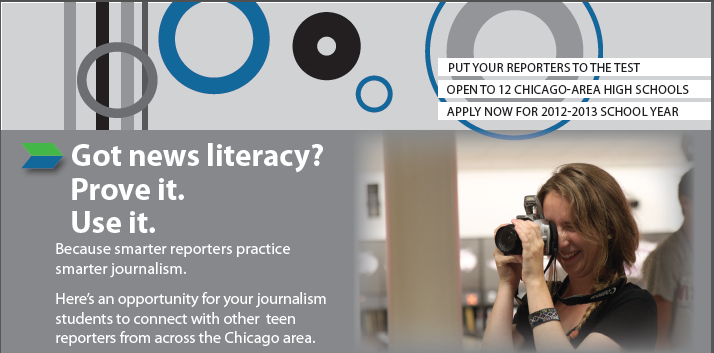
The project is open to 12 Chicago-area high schools. Teachers will attend an in-service prior to the 2012-2013 school year to learn how to apply news literacy to their journalism curriculum. Regular interaction between the student journalists is included in this program.
During this one-year collaboration, journalism and media advisers from across the city and suburbs – print and broadcast alike - will decide on the timely topic to cover. Participating journalism programs will go about their usual reporting, but also produce a special report on the topic chosen by the group. Stories will be due in early 2013 and compiled on a dedicated website and disseminated to mainstream news organization partners.
This project is coordinated by the Midwest Journalism Education Initiative, which supports and promotes journalism education through advocacy, outreach and resources. Letters of application should be sent to the Midwest Journalism Education Initiative at MidwestJEI@gmail.com by April 30, 2012.
Download the flyer and application instructions>
Wednesday, February 22, 2012
Announcing Why News Matters, A New Grantmaking Initiative
Wednesday, February 22, 2012

Today is the formal launch of our Why News Matters initiative. We are excited and curious about response to this new request for ideas (RFI), designed to enhance news literacy in Chicago. We expect to invest about $6 million over the next three years in Why News Matters grants.
The initiative will build on the strong student and teacher training programs at the core of McCormick Foundation's news literacy funding since 2009. We now intend to expand news literacy training in more ways and engage broader audiences throughout the Chicago area.
News literacy is the ability to use critical thinking skills to judge the reliability and credibility of news reports and information sources. It enables citizens to become smarter consumers and creators of fact-based information. It helps them develop informed perspectives and the navigational skills to become effective citizens in a digitally connected society. News literacy programs also emphasize the importance of news and information, the value of reliable sources and appreciation of First Amendment freedoms.
The goal of this RFI is to significantly expand news literacy efforts throughout Chicago. We will solicit ideas and later fund a portfolio of high-impact projects.
Details about the RFI can be found on the Journalism Program section of the McCormick Foundation web site and on the Why News Matters section of the McCormick Media Matters blog.
Apply online through our online grant application system. Note: If you are a new user of the system, you'll need to enter your e-mail address and create a password. If you already are registered with us, you can use your existing McCormick Grant Request log in and password. (Current grantees: This is the same log in and password you used to complete your year-end grant reports).
We also have included a list of 20 Frequently Asked Questions about the RFI. In addition, we will conduct one webinar and two in-person informational sessions for those interested in learning more about this new initiative. You must register to attend these informational sessions.
Depending on the yield of the RFI harvest (remember the April 2 deadline), we expect to invest about $2 million in 2013 in Why News Matters projects. In addition, we anticipate investing another $4 million in the following two years.
We look forward to hearing from you.
Clark Bell
Journalism Program Director
Why News Matters Resources
Wednesday, February 22, 2012
Here is more information about our impact and evaluation strategy for our news literacy work, as well as our current research projects.
Impact & Evaluation
A news literacy evaluation logic model is being developed for the Why News Matters initiative. The model will provide baseline indicators and desired targets for the short-and long-term.
To date, our progress indicators (benchmarks for success) in news literacy have focused on:
▪ Number of schools implementing news literacy.
▪ Number of students reached by news literacy training.
▪ Number of youth journalism programs infusing news literacy into curriculum.
▪ Number of teachers trained in news literacy.
In the longer term (2015), we aim to achieve the following targets:
▪ CPS adopts a news literacy curriculum.
▪ Expand news literacy classes at local colleges and universities
▪ Extend reach of news literacy programs throughout Chicago.
Under Why News Matters, we are looking to expand our indicators to address questions in the Learning & Action Agenda section of the Request for Ideas. Click here for a more comprehensive look at our program logic model.
Current Research Projects
To help us reach long-term targets, McCormick Foundation is partnering on several projects to evaluate the impact of news literacy training on young people. The effort includes developing a set of reliable tools for measuring news literacy impact that is shared with other funders, government leaders, school officials, teachers and parents. The evaluation initiatives in progress are summarized below.
Harvard’s Berkman Center for Internet and Society is carrying out a multi-faceted project with McCormick funding to identify the news literacy approaches with the most impact on conducting focus groups in four cities, to help design a curriculum and toolkit. The goal of the Youth and Media Lab is to illuminate best practices from various disciplines to feed news literacy knowledge and practice.
What we will learn: Knowing how youth use the internet should feed news literacy programs and help them better engage their intended audience. What lessons can the news literacy movement draw from information literacy, media literacy, and youth media to help feed news literacy curricula?
University of Missouri: The McCormick Journalism Program is partnering with Stephanie Craft of the University of Missouri to explore a variety of news literacy evaluation issues. This project will help the determine if levels of news media literacy go hand in hand with pro-social attitudes and behaviors such as interest in current affairs, voting and other forms of civic engagement. Prof. Craft has created a survey tool but will conduct focus groups to further improve the model and then conduct a citywide survey of diverse Chicago teens.
What we will learn: What is the relationship between news literacy knowledge and attitudes toward civic engagement? What is the relationship between participants in youth media and scholastic programs and news literacy awareness? What are the best indicators to assess levels of news media literacy?
McCormick Foundation's 2012 News Literacy Grantees
- Research Foundation for City of New York (Baruch College) for a NYC high school journalism initiative & news literacy symposium.
- City Colleges of Chicago Foundation for student media production and news literacy curriculum.
- Common Sense Media for after school journalism training.
- Florida Gulf Coast University for newsmaker digital conversations with news literacy students.
- Harvard University-Berkman Center for Youth & Social Media Lab research.
- Heartland Alliance Social Impact Research Center for evaluation of youth media initiatives.
- Radio & Television Digital News Association for news literacy training.
- Pulitzer Center for support of Chicago youth media classroom project.
- Strategic Human Services/North Lawndale Community for news internships and news literacy training.
- News Literacy Project for news literacy programs in Chicago Public Schools, including Mt. Vernon Elementary.
- Stony Brook Foundation Inc. for news literacy training & curriculum.
- Univ. of Missouri for news literacy evaluation.
Previous News Literacy Conferences
Setting Learning Goals for News Literacy. Prof. Geanne Rosenberg of Baruch College directed the November 2010 Inaugural High School News Literacy Summit for high school students, educators and observers from journalism and youth media institutions. Baruch also hosted a dinner/brainstorming session for news/media/digital/information literacy funders, leaders and educators. As you set your own news literacy goals, check out the News Literacy Learning Goals that came out of the convening.
Stony Brook University News Literacy Conference. Visit the News Literacy Conference web site chronicling the first national conference on News Literacy. If you didn’t participate in the conference, this is an opportunity to “attend” the conference yourself. Stony Brook has arranged several layers of navigation so you can spend just a few minutes or a few hours exploring the conference. You will learn what News Literacy is. You will meet the conference attendees, including university presidents and top news media leaders. You can watch a presentation on how a course in News Literacy already is being taught to thousands of undergraduates at Stony Brook University. You can experience the conference “breakout” sessions for yourself and hear about a “Big Idea.”
Tuesday, February 7, 2012
Face-to-Face: Conversations with Journalists
Tuesday, February 07, 2012

In January, two St. Pete reporters (Kathleen Flynn and Kris Hundley) discussed their story "Testing Grounds," about drug testing for Big Pharma in India's hospitals.
In February, 22-year-old reporter Alex Pena talks to us from southern Sudan, where he's been reporting for VOA and others for the past month.
In March, we hear from Yemeni reporter Malak Shaher, an Alfred Friendly Press Fellow.
The series runs monthly during the academic year, through April of 2013. After-the-fact replays, along with lesson plans, will be available on Poynter's NewsU for a nominal fee.
Teachers, apply here to participate in a Face-to-Face conversation:
Face-to-Face: Conversations with Journalists is sponsored by the Robert R. McCormick Foundation. It's a partnership between Florida Gulf Coast University and Poynter's NewsU.
Contact Lyn Millner for more information.
Monday, January 23, 2012
Upcoming News Literacy Workshop: Demanding Quality
Monday, January 23, 2012

This free event is open to the public. E-mail rhudak@jot.org to RSVP.
February 13, 6-8 pm, Jane Addams Hull House @ 800 S. Halsted, Chicago IL
Brainstorm: News Literacy in Online Spaces and Public Places
Monday, January 23, 2012

We’re keeping an eye on ways to expand news literacy initiatives through awareness and engagement, curriculum development, training, research and evaluation. We recently came across a news literacy webinar by New York City-based The LAMP (Learning About Multimedia Project). The webinar offers guidance for teachers on how to help students evaluate information from online news sources.
· This 10-minute webinar on “Information Literacy: How to Evaluate Information from News Sources” is led by Katherine Fry, the LAMP’s education director. She uses the Occupy Wall Street movement as a lens for exploring and understanding a variety of websites and blogs.
· The webinar outlines ways to evaluate news sources based on quality of content, the type of source and the presentation vehicle.
· This is one of three webinars that the LAMP is scheduled to produce for World Wide Workshop’s Globaloria, a digital curriculum that uses game design to teach news, civics and digital literacies.
The LAMP also just launched "What's in the News?" workshops for eight branches of the Brooklyn Public Library. They will be holding news literacy workshops for librarians and for the general public (some of these will be held in Spanish). It’s great to see news literacy take root in libraries and public spaces. Our question to you: In what other spaces or platforms could news literacy make an impact?
In the meantime, check out the following news literacy resources from LAMP:
· Check out the News: An introduction to news literacy and understanding how and why news is made.
· The LAMP Resources: Downloadable resource guides on news literacy, digital literacy and media literacy.
--Janet Liao, program officer
--Janet Liao, program officer
Monday, December 5, 2011
“Really?” Curriculum & Contest
Monday, December 05, 2011
“Baby Bacon,” the baby formula that provides jacked-up nutrition levels…the Bed Bug outbreak hitting hotels in major cities…the $100,000 backpacks purchased by the city of Los Angeles for its emergency responders.
All are news stories that were widely disseminated but based on questionable reporting. Their distribution and impact could have been avoided early on, had reporters – or audience members – simply used common sense and asked “Really?”
One safeguard is material provided by the Radio Television Digital News Foundation meant to teach teens to ask common sense questions about news stories. RTDNF has released an innovative set of News Literacy resources for teachers and students. It also is sponsoring a Public Service Announcement contest with a top prize of $1,000 for the winning student and $1,000 for his or her school. The deadline for entry is Dec. 20. RTDNF’s news literacy work targets educators in school (high school, middle school) as well as in nonprofit, after-school settings. We asked Carol Knopes, education director for the RTDNF, to describe what drives the Really? initiative.
Really? is the first question that should come to mind when teens get a text, Tweet, blog, rumor from a friend or a story from the New York Times. Any information at all. Students should certainly ask it before passing along any information. After ‘Really?’, we want teens to ask five other simple questions:
· Who said it?
· Can I trust that person?
· Is that person biased on this subject?
· Am I biased on this subject?
· Where can I go to get more reliable information to make my decision about this information?
We know that the best way to teach teens important journalistic concepts is through hands-on work. Our students have to understand the Really? approach to news literacy before they can start writing their scripts and shooting their video PSAs. We’re looking forward to seeing some creative, sometimes serious, sometime funny takes on how to sort through the deluge of texts, Tweets, blogs, gossip, websites, cable news, broadcast news and newspapers.
Knopes hopes that teachers around the country will adopt these lesson plans and participate in the PSA contest. “We know that teachers are very busy this time of year. Teachers can choose the parts of the webinar and the parts of the lesson plan that they want to present. Their students will see TV news stories that would never have been broadcast if someone had just asked ‘Really?’ We think this is the kind of program that students will very quickly understand and put into practice.”
For more information, go to RTDNF’s High School Broadcast Journalism Project’s website, at www.hsbj.org.
--by Mark Hallett, senior program officer
Tuesday, November 22, 2011
News Literacy: “We Need to Be Teaching This”
Tuesday, November 22, 2011
Professor Lyn Millner of Florida Gulf Coast University (FGCU) reflects on a Nov. 2 news literacy workshop for high school educators. With a McCormick grant, FGCU is carrying out a news literacy program that helps connect classrooms with journalists via video conferencing. Teachers nationwide can apply to participate in the program here: http://www.newsu.org/tools/face-face-conversations-journalists.
Our news literacy night for high school educators went very well. The upshot is that most of the educators plan to institute at least some of the concepts in their classes immediately. I also learned that the new Lee County School Superintendent would be very receptive to learning about how we're teaching news literacy at Florida Gulf Coast University.
I gave the educators an intro to news literacy—what it is and why it matters—using much of what's in Stony Brook's introductory lecture. I told them how our course has made a difference with students.
The reaction from the high school teachers was overwhelmingly positive. Lots of nods and "we need to be teaching this." Nearly all of the teachers said they planned to begin integrating some of these lessons in their current classes. All were grateful for Stony Brook's course materials. (Thank you, Dean and Liz!)
Jennifer Reed, a teacher at South Fort Myers High School told me: “My kids are 18, they're about to go into the world, and it scares me [that they don't have news literacy skills]. Instead, we're teaching them texts such as Chaucer's Canterbury Tales.”
Our discussion naturally broadened to how FGCU's new journalism program can help the high schools in other areas of journalism. Journalism faculty member Rick Kenney led a discussion about specific skills we might address in a spring workshop for high school students. Rick is teaching Journalism & Society (our news literacy course) this year, along with writing, and media law and ethics.
In addition to high school educators, several community members attended, including Paula Sklodowski, an outreach person with WGCU public media; Byron Yake with Write-on Sports; Tony Majeri, retired from the Chicago Tribune and keenly interested in helping FGCU set up a summer high school journalism skills workshop; and David Steckler, on faculty at FGCU and working with Byron to start a middle-school program.
Stay tuned for more updates on FGCU’s work in news literacy education.
Friday, October 28, 2011
Upcoming Nov. 1 Panel Discussion on Balancing Facts and Faith
Friday, October 28, 2011
 The News Literacy Project is teaming up with Chicago's Northside College Prep High School to host a panel discussion event on Covering Religion: How to Balance Facts and Faith in the Search for Truth.
The event starts at 7 pm on Nov. 1, 2011 at the Northside College Prep Auditorium.
NLP invites high school journalism students to cover this event and interview the panelists. They'll even help you arrange an interview. For more information, go to thenewsliteracyproject.org/chicagoevent.
Thursday, October 27, 2011
Teachers: Apply to Participate in a Face-to-Face Conversation with a Journalist
Thursday, October 27, 2011
We're pleased to announce a new news literacy program that helps connect classrooms with journalists via video conferencing.
***
New Journalism Program Receives $42,000 Grant from the McCormick Foundation to Lead Virtual Conversations with Hard-to-Reach Journalists
FORT MYERS, FL -Florida Gulf Coast University’s newly created journalism program has been awarded a $42,000 grant from the Robert R. McCormick Foundation to launch Face-to-Face: Conversations with Journalists. The grant will allow high school, undergraduate and graduate students from across the United States to talk virtually with journalists who have covered news in hard-to-reach areas.
“These are journalists whom students would never otherwise meet,” said Lyn Millner, who leads FGCU’s journalism program and who created the project. “Students will learn how these reporters make decisions, verify information and report the truth—especially in challenging environments.”
FGCU will partner with Poynter’s News University in St. Petersburg, Fla., and with Stony Brook University’s Center for News Literacy in Long Island, NY, to produce the Face-to-Face conversations. Millner and new associate professor of journalism Rick Kenney will develop companion teaching resource materials as part of the project.
“We welcome FGCU to our grantee portfolio,” said McCormick Foundation Journalism Program Director Clark Bell. “News literacy anchors our strategy of building a more informed, news-literate and engaged citizenry. We expect the FGCU-Stony Brook-Poynter collaboration will make a major contribution to the effort.”
Face-to-Face is part of a national news literacy education movement, which FGCU has brought to southwest Florida. FGCU is one of only two higher-education institutions in Florida that are formally involved with Stony Brook’s Center for News Literacy.
“Poynter NewsU is excited that these conversations will be a resource for teachers from around the world,” said Howard Finberg, News University’s Director of Interactive Learning.
The first Face-to-Face conversation will be held in January 2012. High schools and universities may apply to participate in a Face-to-Face conversation at Poynter’s NewsU: www.newsu.org/fgcu_face2face
For more information contact Lyn Millner at (239) 590-7257 or lmillner@fgcu.edu.
-FGCU-
About Florida Gulf Coast University
Florida Gulf Coast University, a member of the State University System of Florida, is a comprehensive university created to address the educational needs of the rapidly growing Southwest Florida population. FGCU continuously pursues academic excellence, practices and promotes environmental sustainability, embraces diversity, nurtures community partnerships, values public service, encourages civic responsibility, cultivates habits of lifelong learning, and keeps the advancement of knowledge and pursuit of truth as noble ideals at the heart of the university’s purpose.
About the Robert R. McCormick Foundation
The Robert R. McCormick Foundation is committed to fostering communities of educated, informed and engaged citizens. Through philanthropic programs, Cantigny Park and museums, the Foundation helps develop citizen leaders and works to make life better in our communities. The Foundation was established as a charitable trust in 1955, upon the death of Colonel Robert R. McCormick, the longtime editor and publisher of the Chicago Tribune. The Robert R. McCormick Foundation is one of the nation's largest foundations, with more than $1 billion in assets. For more information, please visit www.McCormickFoundation.org.
About Poynter’s News University
Poynter’s News University (http://www.newsu.org) offers training to journalists, journalism students, teachers and the public through more than 225 interactive e-learning modules and other forms of training. It has more than 195,000 registered users in 225 countries.
The Poynter Institute trains journalism practitioners, media leaders, educators and citizens in the areas of online and multimedia, leadership and management, reporting, writing and editing, TV and radio, ethics and diversity, journalism education and visual journalism. Poynter's website, (http://www.poynter.org) is the dominant provider of journalism news, with a focus on business analysis and the opportunities and implications of technology.
Friday, June 10, 2011
OMG: Taking students from digital users to good digital citizens
Friday, June 10, 2011
Technology is giving students the power to do things that other generations couldn’t have ever imagined. But with this new power comes new challenges such as, recognizing spin from fact and knowing how to identify verified news sources.
This summer, the McCormick Foundation Journalism program is partnering with experts at San Francisco-based Common Sense Media (CSM) to develop a Digital Literacy and Citizenship curriculum for Chicago communities.
CSM’s summer activities include helping train educators to teach students how to be safe, respectful and responsible digital citizens. A recent webinar presented to Chicago Public Schools educators offers guidance and lesson plans covering online safety, creating strong passwords, evaluating online information, and searching effectively for news and information.
The webinar and summer prep kit will be available for viewing at this link.
Wednesday, April 13, 2011
Grantee Spotlight: The News Literacy Project on Empowering Teens Through News Literacy
Wednesday, April 13, 2011

At a brown bag lunch session for After School Matters staff on March 30, 2011, Peter Adams from The News Literacy Project offered an overview of the field of news literacy; explained why it is an essential part of developing empowered, responsible digital citizens; and offered some relevant ways that this content may be used in after school settings.
The area of news literacy has gained important attention in recent years as the news and information landscape continues to undergo rapid and radical changes. Ever since the rise of cable news networks, and the 24-hour news cycle, consumers have experienced an explosion of sources for information, especially on the Internet. But navigating these sources, and understanding the varying levels of bias and credibility that they employ, pose significant challenges for everyone.
As so-called “digital natives,” the current generation of young people arguably has more opportunities for meaningful civic engagement than any other, but it likely also faces unprecedented levels of misinformation and distortion as well. Learning to separate fact from fiction in the digital age is an essential skill set—one that can be incredibly empowering for rising citizens.
The News Literacy Project partners with schools and youth organizations to help students sort fact from fiction, evaluate information sources and learn why quality journalism is important to a healthy democracy.
To learn more about The News Literacy Project, click here.
Check out their blog for ideas on how to use news literacy in the classroom.
Subscribe to:
Posts (Atom)